SLEEPCOACHGAME · answers

Does alcohol affect deep sleep?

Yes. Alcohol is a sedative, so it helps you fall asleep faster — but it suppresses deep sleep in the first half of the night and fragments the second half as your body clears it, with more awakenings and a REM rebound. The result is a full night in bed that leaves you unrefreshed.

Find and fix
one deep sleep thief habit
in 58 seconds
Free

No download · any device · your AI Coach gives the fix

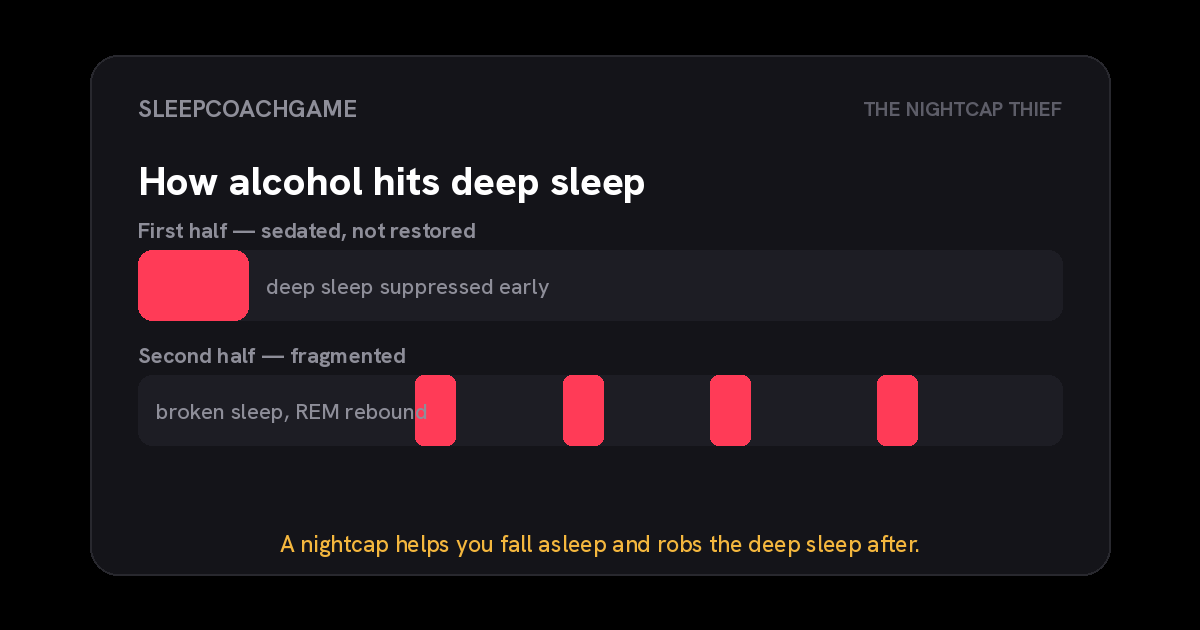
Two halves of the night showing alcohol's effect: deep sleep suppressed early in the first half, and broken, fragmented sleep with REM rebound in the second half.
A nightcap helps you fall asleep and robs the deep sleep after. Sedation is not restoration.

The nightcap trap

It helps you fall asleep, then steals the deep part.

Faster to sleep, worse sleep. Alcohol is a sedative, so you drop off quickly — but sedation is not the same as restorative sleep.
Deep sleep suppressed early. In the first half of the night, when deep sleep should peak, alcohol blunts it.
Fragmented second half. As your body clears the alcohol, sleep breaks up — more awakenings and a REM rebound — so the back half is shallow and restless (Ebrahim et al., 2013).

The result: a full night in bed that leaves you unrefreshed. A nightcap trades quick sleep now for the deep sleep that actually restores you.

The swap

Catch the nightcap thief.

You do not have to quit to protect deep sleep — moving the last drink earlier and leaving a gap before bed is often enough. SLEEPCOACHGAME shows you 12 real-life scenes in 58 seconds, including the evening drink, you answer Green Light or Red Light, and your AI Coach names the thief your round caught and the swap that gives your deep sleep.

Deep sleep turns waking up into something you look forward to.

Buy SLEEPCOACHGAME55 games · one-time · secure Paystack checkout

ZAR 780, appr. $47 · 55 games, yours to keep

Not for you? Fewer than 10 games played — full refund.